The Compost Turner
Developing the Turner
Over the past few months, we’ve been working through the early concepts for the turner, and most of them didn’t quite land the way we expected. The first direction we explored was a lid-mounted design, where the mechanism would sit on top of a compost bin and rotate from above. It felt like a clean and contained solution, with everything integrated into one system. On paper, it made sense, but once we started thinking through real conditions, wet, compacted, uneven compost, it became clear that the loads and forces wouldn’t be as simple as we first thought.
What We Were Aiming For
From the beginning, we wanted to keep things simple. The goal wasn’t to replace compost bins, but to build something that could be added to what people already have. We wanted a design that existing bin owners could retrofit themselves with minimal effort. No complicated setup, no specialised tools, just something practical that improves how composting works. Keeping the barrier to entry low has been a key driver in how we’ve approached the design so far.
What We Ran Into
Two main challenges showed up pretty quickly. The first was torque. As compost builds up, especially when it becomes drier and more compacted, it gets significantly harder to turn. What starts off easy doesn’t stay that way. In the lid-mounted concept, that force was being transferred directly into the plastic lid. In practice, this led to the lid flexing and starting to deform under load. It became clear that over time, it wouldn’t hold up.
Reducing the Barrier
At the same time, we realised that requiring people to drill into their bins or make permanent modifications would likely put them off. Even if the system worked well, most people aren’t going to want to alter their bin in a fundamental way. That runs against the idea of making composting easier and more accessible. If anything, the design should reduce friction, not add more of it. This reinforced the need to keep things simple and compatible with existing setups.
Shifting the Approach
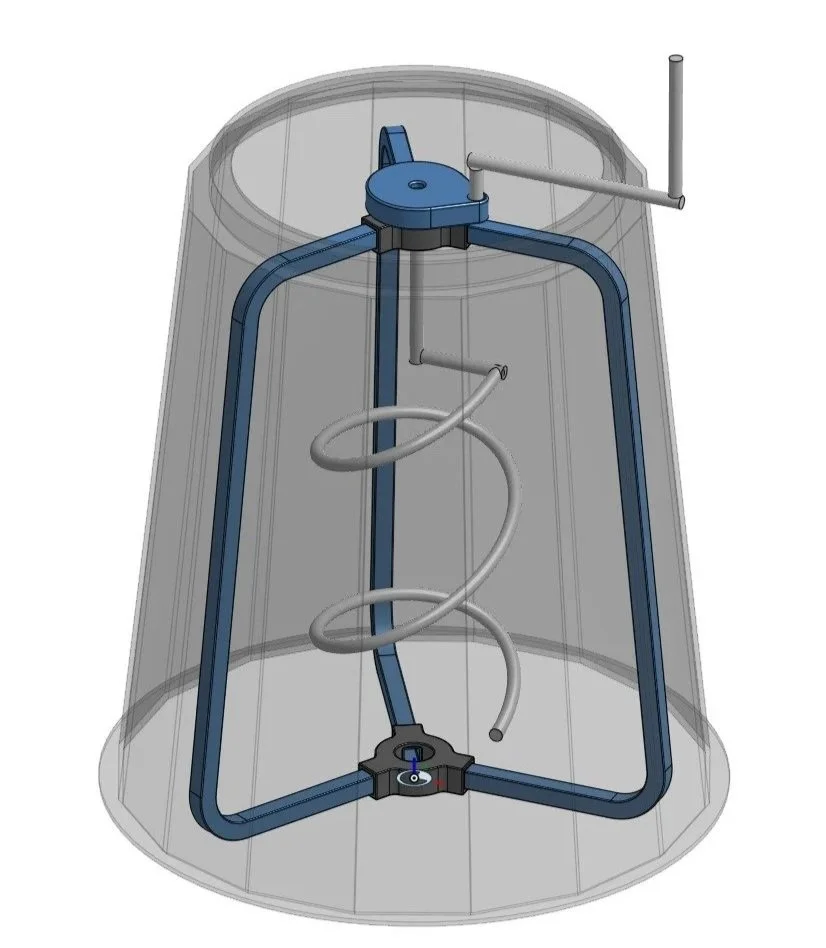
Because of that, we started moving away from the lid-mounted idea and looking at alternative approaches. One direction we’ve been exploring is a frame-based concept that sits inside the bin and manages the load independently. This removes stress from the lid, improves stability, and avoids the need for modifications altogether. It’s a more practical solution, even if it’s less integrated than the original idea, because it actually holds up under real conditions.
What Comes Next
With the overall structure starting to take shape, the next step has been focusing on the turner itself and how it interacts with the compost. So far, we’ve been exploring a few different approaches. One is a dough hook style design, intended to pull material through and break it apart. Another is a spinning erg style, which focuses more on mixing and agitation. Both have their pros and cons, and it’s not yet clear which direction will perform better. That’s what we’ll keep testing as we continue developing the design.